
Change requests
Review and approveThe video is narrated in German; you can switch on subtitles in the player. Playing the video connects to YouTube (Google). More in the privacy policy · Watch on YouTube
Once a state has been agreed with the customer and recorded as a baseline, changes should not simply happen but be decided deliberately. This is what change requests (CR) are for.
Process
| Step | Who | What |
|---|---|---|
| 1. Request | role COMMENT and above | title, description of the change, reason or trigger, affected artifacts and the reference state (baseline). The group admins are notified. |
| 2. Assess | everyone | The request automatically lists all artifacts connected to the affected ones via links (up to two steps), with their distance. This is the basis for effort and risk. |
| 3. Decide | group admin | Accept or Reject, with a note. The person who submitted the request is notified. |
| 4. Implement | role EDIT and above | Change the affected artifacts. Dependent links become suspect and must be checked. Then Mark as implemented. |
| 5. Prove | everyone | Comparing the new baseline with the reference state shows exactly what has changed. |
Submitting a request
- On the artifact page with Request change: the artifact is then already entered as affected.
- Or via Change requests → New change request in the project overview.
Each request receives a consecutive number in the project (CR-1, CR-2, …). The list shows all requests with their state: requested, accepted, rejected, implemented.
Interaction with other functions
- Suspect links show during implementation which derived requirements and test cases have to be followed up (Traceability).
- The metrics count open requests and accepted requests not yet implemented (Metrics).
- After implementation, a review of the changed artifacts and a new baseline are recommended.
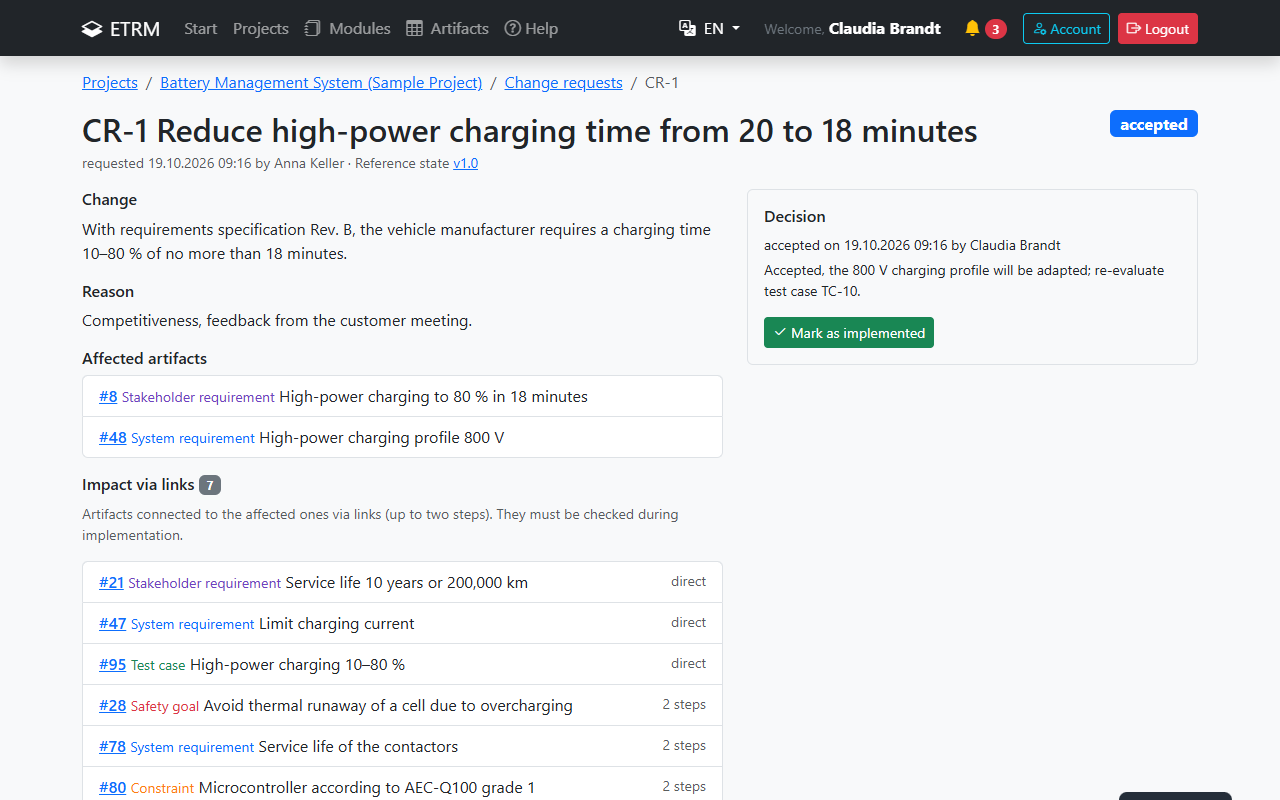
Example from the sample project: CR-1 “Reduce high-power charging time from 20 to 18 minutes” concerns one stakeholder and one system requirement. The impact covers seven further artifacts, including the fast charging test case and a safety goal.